Reimagining Food Charity: What it Means to Build Solidarity Beyond the Food Bank
Kayleigh Garthwaite introduces her new and important book on strategies for democratically transforming our food system
One of the central arguments of Hunger Inc. is that we must shift from a charity model to a rights‑based one. The Right to Food is a legally recognised human right, first set out in the 1948 Universal Declaration of Human Rights and later enshrined in the 1966 International Covenant on Economic, Social and Cultural Rights.
Since 2020, demand for charitable food aid has risen sharply across North America and Europe. While we know food banks were in place long before the pandemic, the overlapping crises of COVID‑19, inflation, and widening inequality dramatically accelerated their use and deepened their role and visibility in society. Corporate‑backed charitable food aid expanded on a large scale, often reliant on donations of surplus food that can be unfit for purpose. As a result, governments have increasingly shifted responsibility for hunger onto a charitable system propped up by corporate donations.
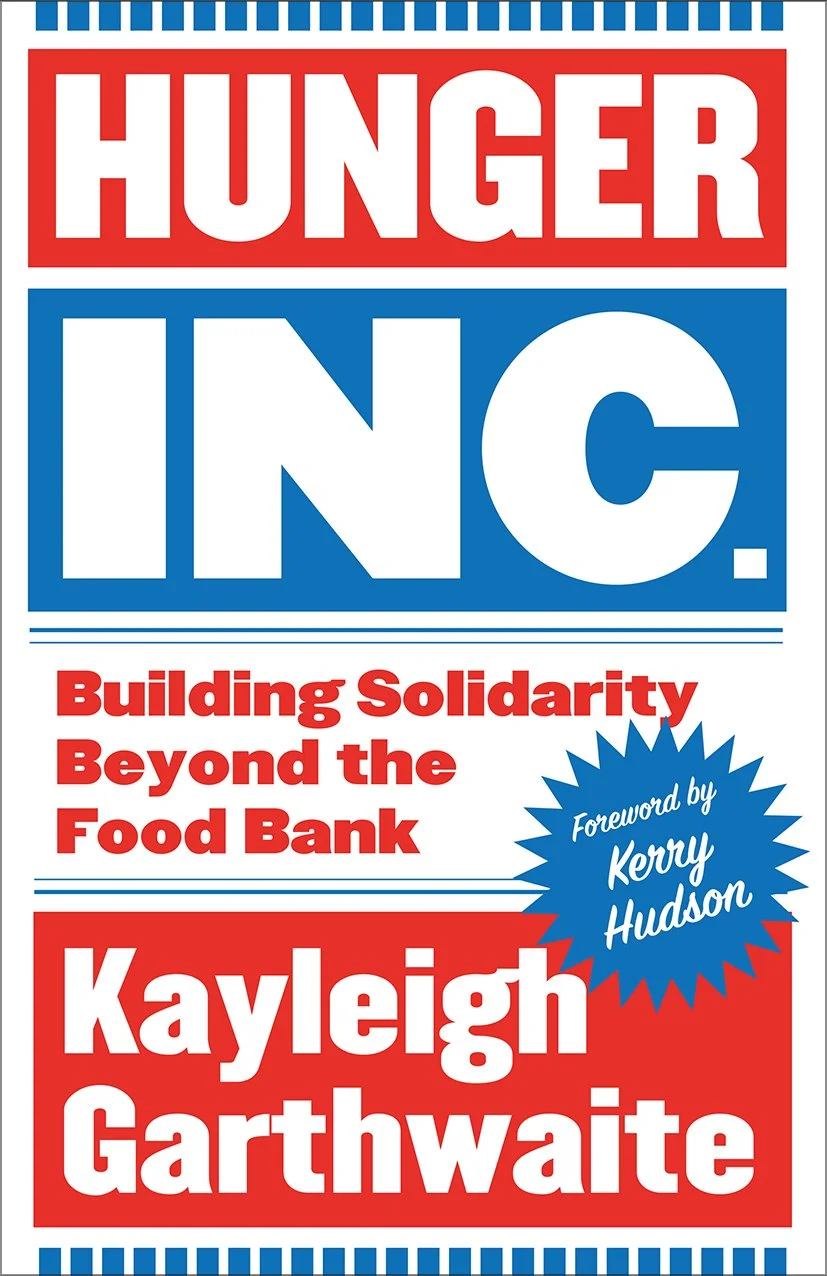
My new book, Hunger Inc.: Building Solidarity Beyond the Food Bank, examines what this shift means for people, communities, and the future of food justice. The book asks a simple but pressing question: what happens when charity becomes the default response to hunger in rich but unequal countries?
To explore this, I travelled across the US, Canada and Europe, spending time with food banks, co‑ops, community kitchens, urban farms and food justice organisations. I volunteered, observed, and listened. Across all of the six countries I visited, it was clear that charitable food aid can alleviate immediate hardship temporarily, but it can’t address the structural forces that produce food insecurity in the first place.
The Politics of Charitable Food Aid
Across the 90+ organisations I visited, almost all spoke the language of dignity, choice and community. Many spoke of a right to food. Yet the reality was often constrained by scarcity, stigma, and the power dynamics inherent in charity. Research, including my own, shows that food charity can leave people feeling judged or undeserving, and that these experiences are shaped by class, gender, disability, race, and immigration status.
At the same time, wider narratives can frame hunger as an individual problem - a matter of budgeting, cooking skills, or personal responsibility. These myths endure because they are politically convenient. They obscure the fact that food insecurity is driven by income, housing, social security and structural inequalities, not by personal ‘failings’.
Campaigns that celebrate volunteers as ‘heroes’ reinforce the idea that charity is an accepted response to poverty. But this narrative keeps us stuck. It normalises a parallel food system for people experiencing poverty and allows governments to step back from their obligations.
Reframing the Debate: The Right to Food
One of the central arguments of Hunger Inc. is that we must shift from a charity model to a rights‑based one. The Right to Food is a legally recognised human right, first set out in the 1948 Universal Declaration of Human Rights and later enshrined in the 1966 International Covenant on Economic, Social and Cultural Rights. At its simplest, it means that everyone should have reliable, dignified access to adequate, nutritious and culturally appropriate food - not as charity, but as a legal entitlement.
This is the work I’ve been doing as a co‑founder of the Global Solidarity Alliance for Food, Health and Social Justice (GSA), a network committed to challenging the dominance of charitable food aid and advancing rights‑based, justice‑oriented alternatives. The GSA brings together food bank workers, researchers, advocates and people with lived experience to reshape the narrative around hunger and push for systemic change.
Across the US and Europe, rights‑based movements are gaining momentum. In the UK, the Right to Food Commission led by Ian Byrne MP is gathering evidence and building public pressure for the Right to Food to be enshrined in law, strengthening the case for systemic change. In West Virginia, Voices of Hunger is organising people with lived experience to advocate for municipal Right to Food resolutions. Nourish Scotland’s work on public diners imagines a future where communal meals are part of national infrastructure. These initiatives illustrate how communities are beginning to move beyond short‑term crisis responses toward deeper, long‑term transformation.
Solidarity in Practice
Alongside diagnosing the structural problems that keep charitable food aid in place, Hunger Inc. devotes equal attention to the alternatives already being built. I wanted the book to spend as much time imagining what solidarity based alternatives can look like as it does analysing why the current model fails.
Mutual aid groups, solidarity kitchens and food sovereignty movements are creating systems rooted in collective care, shared responsibility, and local control. These spaces are not perfect. Frontline workers and volunteers face burnout, funding precarity and political resistance - but they show what it looks like to practise a more just food system grounded in solidarity and rights, not charity.
The book argues that while community responses matter, they can’t replace state responsibility. Ending hunger requires political will and structural change. That means:
• Adequate income guarantees, including exploring cash-first and Universal Basic Income models
• Robust social security systems
• Universal free school meals
• Legal recognition of the Right to Food
• Narrative change that challenges stigma and charity
These are not radical ideas. They are the minimum required to ensure that people do not have to rely on charity to meet their basic needs.