Food is a Gateway Right
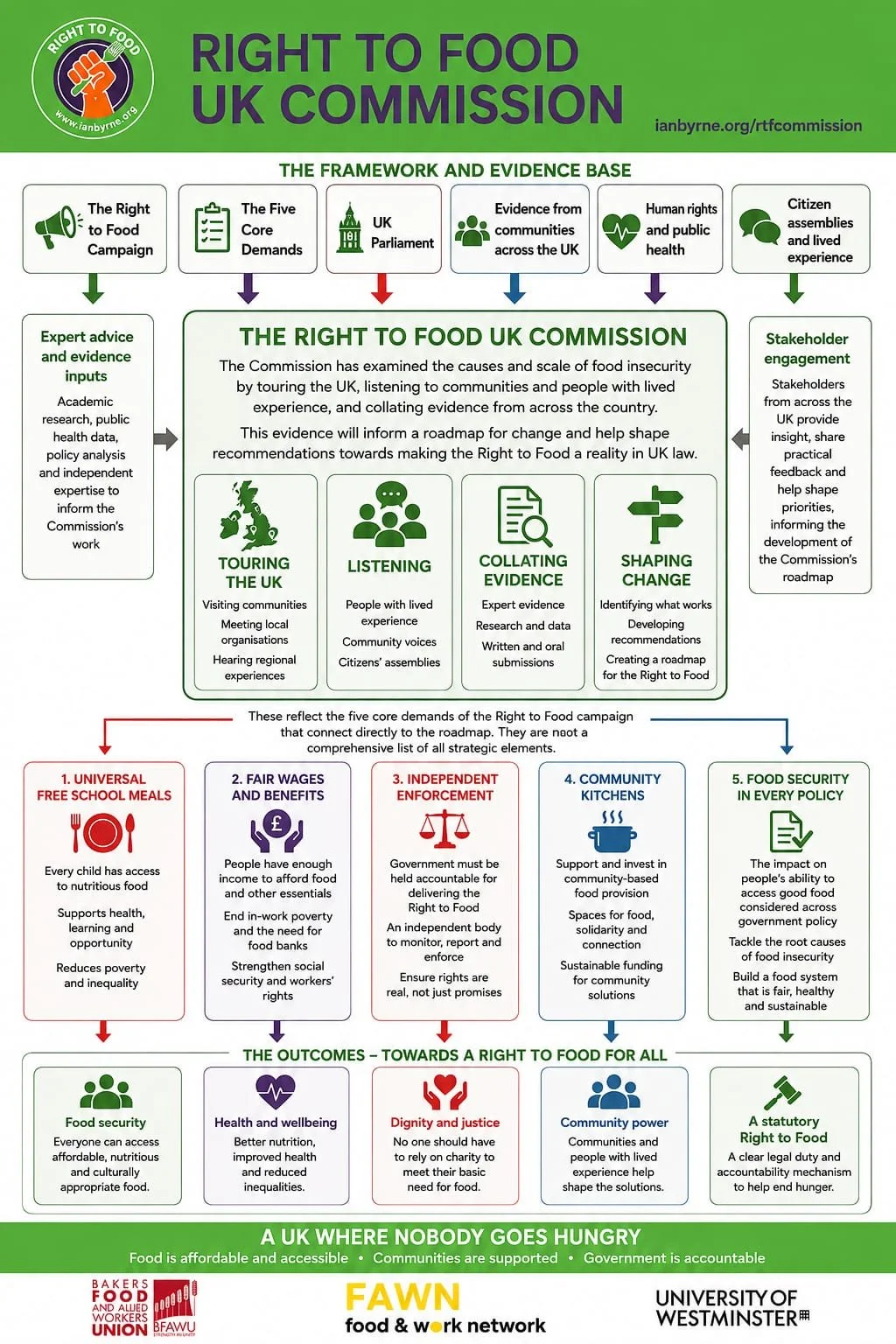
Over the last eight months as part of the Right to Food UK Commission, I spent time listening to people from across the UK talk about food insecurity.
I've spent much of my career in work linked to social justice issues like poverty, health inequality, social security and homelessness. Despite these years under my belt, listening to the Commission's evidence, I had a light bulb moment; food has become the fault line through which so many injustices reveal themselves.
One thing is so clear: food is the gateway right. When people cannot access good food, other rights quickly begin to unravel: health, housing, education, work, family life, participation and dignity.
The UK has committed internationally to the right to adequate food as part of the International Covenant on Economic Social and Cultural Rights, yet unlike other human rights, it has never been properly incorporated into domestic law. That means Westminster governments can make decisions that affect people's ability to access food without ever having to ask whether those decisions will leave more families struggling. There is no framework, no standard, no duty and no accountability mechanism requiring ministers to consider the impact on hunger and food insecurity when they are passing policy.
What the Right to Food Commission Heard
Since January, the Right to Food Commission has gathered evidence from communities, academics, campaigners, charities, businesses. We have heard how access to good food is harder for children, disabled people, lone parents, carers, people seeking asylum and refugees. We have heard about the daily trade-offs families are forced to make simply to survive.
The impossible choice between "heating or eating" has become a familiar phrase. Maybe because it rhymes, it rolls easily off the tongue. But it has always felt to me too be too simplistic. It condenses harsh realities down to something that sounds like it can be fixed if you put a thicker jumper on. The reality is much harder to hear.
The real choices include: can a disabled person can afford to charge their wheelchair and still eat? Can a parent eat dinner or quietly go without so their child can? Will an asylum seeker living in temporary accommodation be forced to eat food that is against their religious beliefs? Will a coeliac be forced to choose between hunger and the food that may damage their health? Can an older person access nutritious meals when the social care team only has 15 minutes a day with them? Will a child arrives at school ready to learn or be distracted by hunger?
Hunger and food insecurity is not a problem of food shortage. It is a problem of poverty. It is the result of being powerless to act to stop the interplay between escalating prices of food, housing, and energy and woefully inadequate incomes, which is then compounded by debt.
Communities told us repeatedly that food is the thing that gives way first. Food is often the only flexible item in a household budget. You can skip meals. You can buy cheaper processed food. You can eat less. You cannot simply decide not to pay the rent. As one person said in an evidence session “Rent eats first”.
Breaking the Vicious Cycle
The urgency for action is real with drought and geopolitics pushing us towards an even greater crisis. In 2008, financial institutions gambled with money in the mortgage market and when the bubble burst, ordinary people paid the price and austerity years began.
Today, it feels as though we have created a new bubble, but this time the financial locus is not money in a bank, it is the commodified life's essentials like food and rented housing. As prices rise, families need more support just to stand still. Government spends more on social security, local authorities spend more on crisis provision, and public services absorb the consequences of worsening poverty. As money flows into increasingly concentrated and expensive food and rental markets, so too does more public funds targeting poverty ultimately end up in the pockets of shareholders and landlords.
The result is a vicious cycle. Food prices rise. Poverty increases. Debt widens. Fiscal pressure grows. Public services come under strain. Blame culture and stigma fuel social unrest. More people are pushed towards food aid and live in fear. The costs of inaction accumulate everywhere and the bubble feels like it is about to burst.
For a Right to Food Law
A right to food law offers a structural way to start breaking that cycle. Of course, legislation alone will not put dinner on the table or money in people’s pockets. We still need policies like the Essentials Guarantee and Cash First responses to emergency food aid, to increase household incomes, strengthen social security alongside measures to improve wages, expand free school meals and planning laws to help create healthier food environments.
But policy solutions like these come and go on the shifting political winds. We have learnt that the hard way. Meals on Wheels disappeared. Youth services disappeared. Community infrastructure disappeared. Social Security was cut, capped and frozen. Support that once seemed permanent was gradually eroded without any way to challenge that.
Rights are different. A right creates a framework to tie these food sensitive policies to principles, such as requiring future governments to consider how a decision impacts on inequality and access to food. Just as the Human Rights Act acts as a goalkeeper for many of our civil and political rights, a Right to Food law could act as a safeguard for economic and social rights policy.
Government Responsibilities
The communities who contributed evidence to the Commission were remarkably clear about what such a law should set as binding targets for government: nobody should go hungry; everyone should have access to nutritious food; incomes should be sufficient to afford a healthy diet; children's needs should be protected; support should be delivered with dignity; government should be accountable when things go wrong. Government needs to accept it has a duty to respect, protect and fulfil the Right to Food and create the plans to deliver this.
Amnesty International polling, told us an overwhelming almost 9/10 people believe that government must not be able to pass policy that makes access to food worse. Ultimately, that is why a right to food law matters. Not because it replaces policy solutions, but because it protects them from political choices that make standards of living worse. It would force governments to ask a simple question every time they make decisions on welfare, employment, housing, immigration or public spending:
Will this make it harder for people to access good food? If the answer is yes, they must think again. Because in the sixth richest country in the world, hunger and food insecurity should never be an acceptable policy outcome. The challenge now for the Right to Food Commissioners is to digest all the swathes of evidence and create a report and recommendations that help the Government chart a path away from charity towards a food-secure society. If government is serious about building a fairer, healthier, hopeful and more resilient society, the right to food can no longer remain a moral aspiration. It needs to become a legal guarantee.